San Diego has a reputation as a place built for cars, and for good reason: the freeways are the region’s main arteries. But the county also has a sizable transit network, and for trips to downtown, the university, Mission Valley, the border or a ballgame it can be the easier choice. The network is run by several agencies, which is the first thing that trips up newcomers. Once that is sorted out, using it is straightforward.
Who runs what?
Most of the service people think of as “the Trolley and the bus” is operated by the San Diego Metropolitan Transit System, known as MTS. MTS serves the urbanized part of the county, including the city of San Diego, Chula Vista, National City, La Mesa, El Cajon and Santee, and it describes its service area as roughly three million residents. A 15-member board of directors governs it, with members appointed by the City of San Diego, the City of Chula Vista, eight other city councils and the County Board of Supervisors.
The North County Transit District, called NCTD, covers the northern part of the county. It runs the COASTER commuter trains between Oceanside and downtown San Diego, the SPRINTER hybrid rail line between Oceanside and Escondido, and bus routes in North County. Amtrak’s Pacific Surfliner also stops in San Diego, a topic covered in riding the Pacific Surfliner.
Planning and funding for the whole region fall to a different body, covered in what SANDAG does.
What are the Trolley lines?
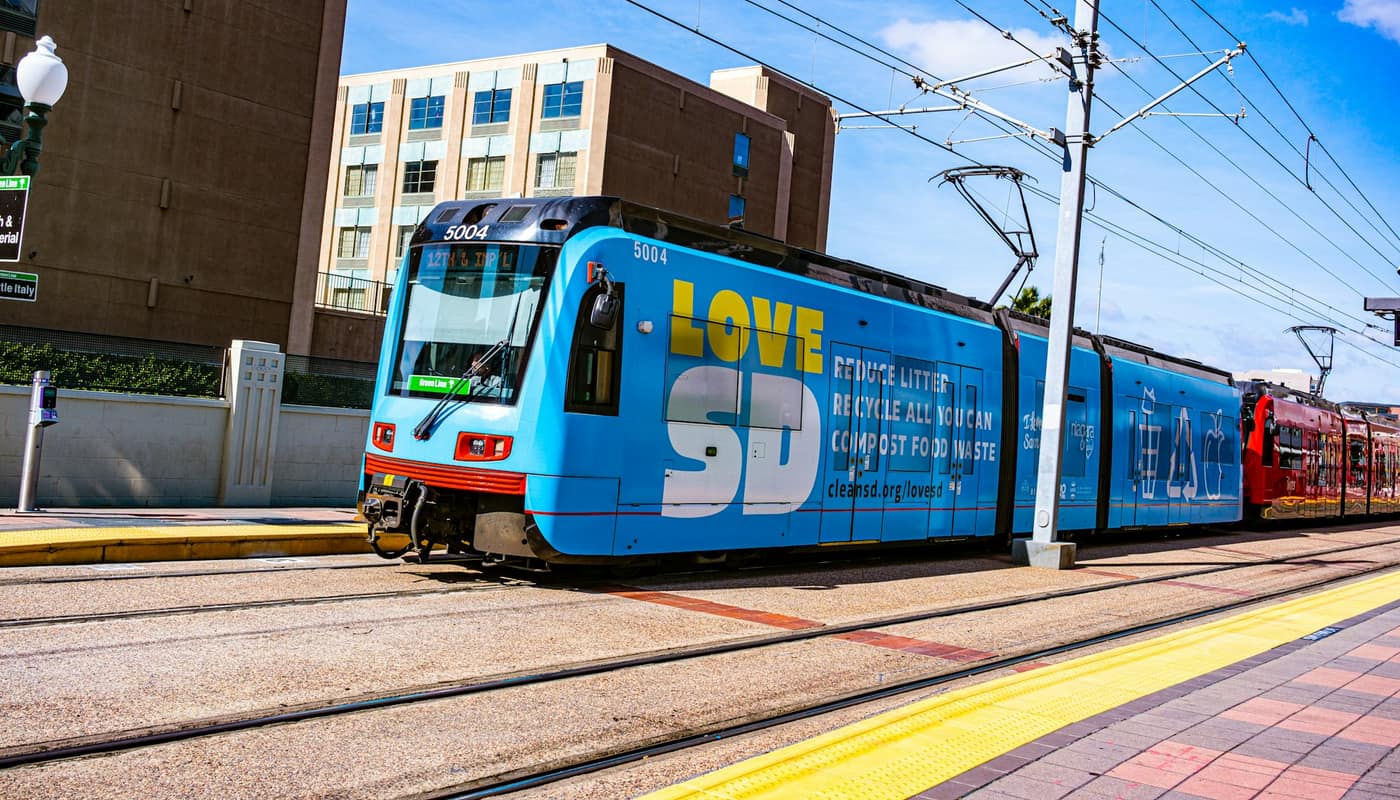
The San Diego Trolley is a light-rail system. MTS identifies its lines by name and color:
- The UC San Diego Blue Line runs between the university area in the north and the San Ysidro border area in the south, passing through Old Town, downtown and Chula Vista.
- The Orange Line serves downtown and communities to the east, including La Mesa and El Cajon.
- The Green Line connects downtown with Old Town, Mission Valley, San Diego State University and Snapdragon Stadium.
- The Copper Line links El Cajon with Santee in East County.
- The Silver Line is a heritage streetcar loop in downtown that operates on a limited schedule and is more a sightseeing service than a commuter line.
Routes and service patterns change, so check the current system map and timetable before a trip. MTS describes the Trolley as five lines with dozens of stations, and it runs alongside roughly 100 fixed bus routes, including local, express and rural services, plus a paratransit service called MTS Access for riders whose disabilities prevent them from using regular transit.
How do fares and payment work?
MTS lists adult fares of $3.00 for a one-way ride and $7.00 for a day pass, with reduced fares for eligible riders who carry proper ID, such as seniors, people with disabilities and Medicare cardholders. Premium and express routes cost more. Fares can change, so treat those figures as a snapshot and confirm them on the agency’s website.
Riders have several ways to pay:
- A PRONTO card or the PRONTO app. PRONTO is the region’s fare system. Loading money onto the card or app lets a rider tap on and off, and the system applies fare capping, meaning that after enough rides in a period the rider stops paying more.
- A contactless credit or debit card. Riders can tap a bank card at the reader. This is convenient for visitors, though fare capping generally works with PRONTO rather than with bank cards, so frequent riders usually come out ahead with PRONTO.
- Cash. Cash is accepted on buses, and ticket machines at Trolley stations accept it too.
A common mistake is forgetting to tap. Trolley stations do not have turnstiles. Riders are expected to pay before boarding by tapping at a validator on the platform, and fare inspectors check for proof of payment. A rider who has not paid can be cited, so tapping every time is worth the few seconds.
Where do the systems connect?
Transfers are easier than they look because the region’s main hubs sit close together downtown and in Old Town.
- Santa Fe Depot downtown is a hub for the Blue and Green lines, COASTER commuter trains and the Pacific Surfliner.
- Old Town Transit Center brings together the Trolley, COASTER, the Surfliner and many bus routes. It is a common starting point for visitors heading to the historic district.
- Oceanside Transit Center is where COASTER meets the SPRINTER in North County.
- 12th and Imperial Transit Center downtown connects several Trolley lines and buses.
Regional day passes exist that combine MTS and NCTD services, which is useful for a day trip from Oceanside to a downtown event. The rules differ by pass, so check which services a pass covers before buying.
What are the practical tips?
Some habits make trips go smoothly:
- Use a live trip planner. Apps and the MTS trip planner show real-time arrivals, which are more reliable than printed schedules.
- Allow time on game and event days. The Trolley and COASTER both serve Petco Park and Snapdragon Stadium, as described in the Petco Park guide, and trains fill up before and after events.
- Check for service alerts. Construction and track work occasionally replace Trolley service with shuttle buses on certain segments.
- Mind the doors. Trolley doors on some cars open by button, and on certain vehicles a rider has to press it to board.
- Make room for bikes and luggage. Bikes are allowed on Trolley cars and buses, with space limits, and airport travelers have bus connections discussed in how San Diego International Airport is run.
What about accessibility and safety?
Trolley vehicles and stations are designed for riders who use wheelchairs and other mobility devices, and buses have lifts or ramps and priority seating. Riders who need extra help can use MTS Access, the paratransit service for people whose disabilities prevent them from riding regular routes, though eligibility has to be established first. As on any transit system, riders can report problems to MTS, which has security staff and contracted security officers on the network, and the agency lists a way to report concerns by phone or app. Keeping valuables out of sight and staying aware at platforms late at night are the same sensible habits that apply on any public transit.
Is transit a practical choice?
It depends on the trip. For travel along the Blue and Green lines, or between downtown and the coast by COASTER, it is often competitive with driving, especially when parking costs and traffic enter the comparison. For trips between suburban areas that the network does not link directly, it can take much longer than a car. The region’s planners have been shifting toward more frequent service and new rail and bus corridors in response, and decisions about where to put those investments are made through the regional planning process.
For a first trip, the simplest approach is to pick a destination on the Trolley, load a PRONTO card or use a phone app, and ride one line from end to end. The system is easy to learn by doing, and one trip is usually enough to see whether it fits the way someone moves around the county.
Sources: San Diego Metropolitan Transit System; North County Transit District; PRONTO; Amtrak