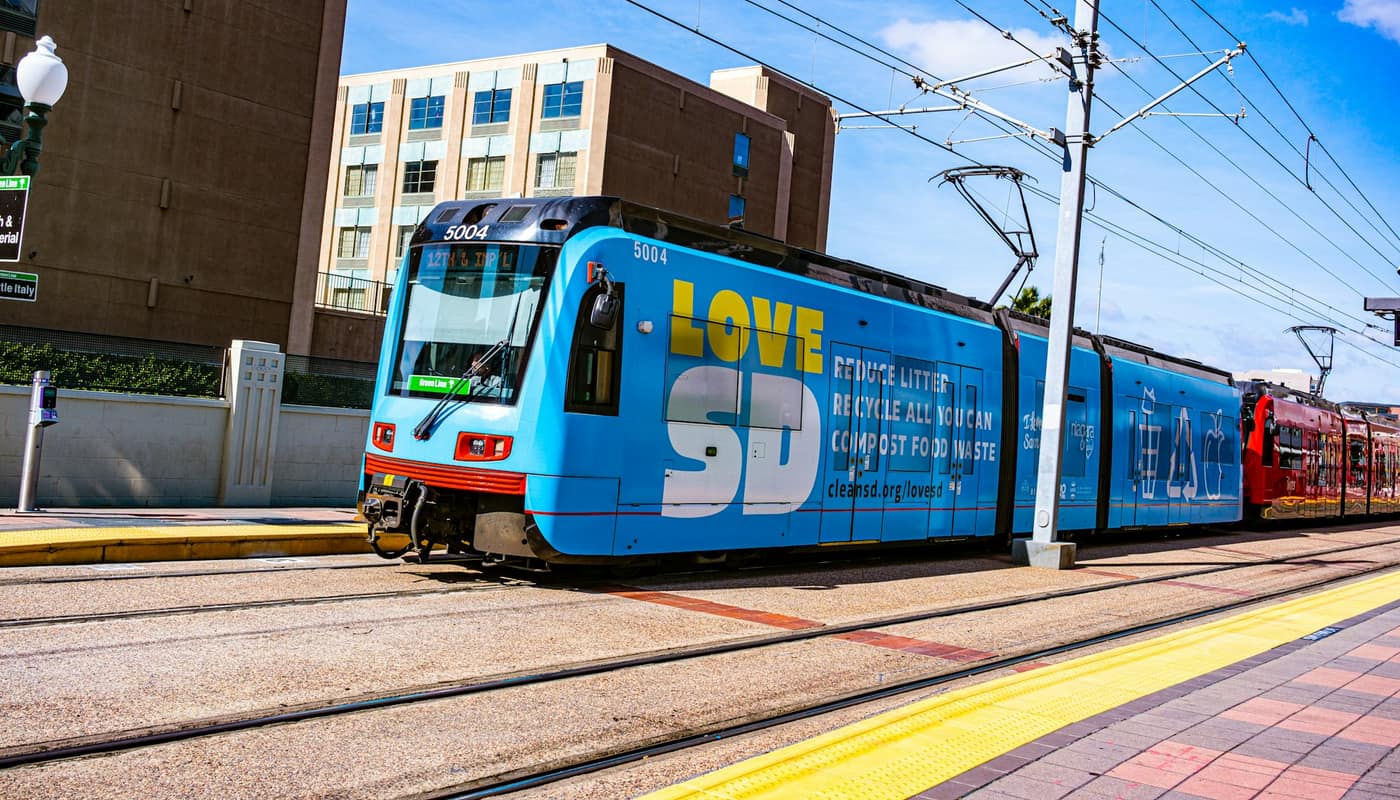
The San Diego Trolley is a light-rail system that links downtown San Diego with UC San Diego, East County, the South Bay and the border with Mexico. According to the San Diego Metropolitan Transit System (MTS), it runs on four lines, each with its own color, and riders pay a flat fare that depends on who they are rather than how far they go.
This explainer looks at the system’s structure: how the lines connect, what the fares are, how people pay, and who built and funds the newest stretch of track. For a step-by-step guide to a first ride, see the separate practical guide to riding the Trolley and MTS buses.
What exactly is the San Diego Trolley?
“Light rail” means electric passenger trains that run on their own tracks, usually in shorter trains and with closer station spacing than a heavy commuter railroad. The Trolley fits that description: it is a rail network inside the urban part of the county, not a long-distance commuter train.
MTS, the region’s main transit agency, operates it and publishes its lines, schedules and fares. Service to the northern part of the county is a separate matter, handled by the North County Transit District. The Trolley’s reach goes as far north as the UTC Transit Center near UC San Diego, as far south as the San Ysidro Transit Center at the border, and as far east as El Cajon and Santee.
Which four lines make up the Trolley?
As of November 2026, according to MTS, the Trolley has four lines:
| Line | Where it runs, per MTS |
|---|---|
| Blue Line (UC San Diego) | From the UTC Transit Center in La Jolla through downtown and the South Bay to the San Ysidro Transit Center at the border |
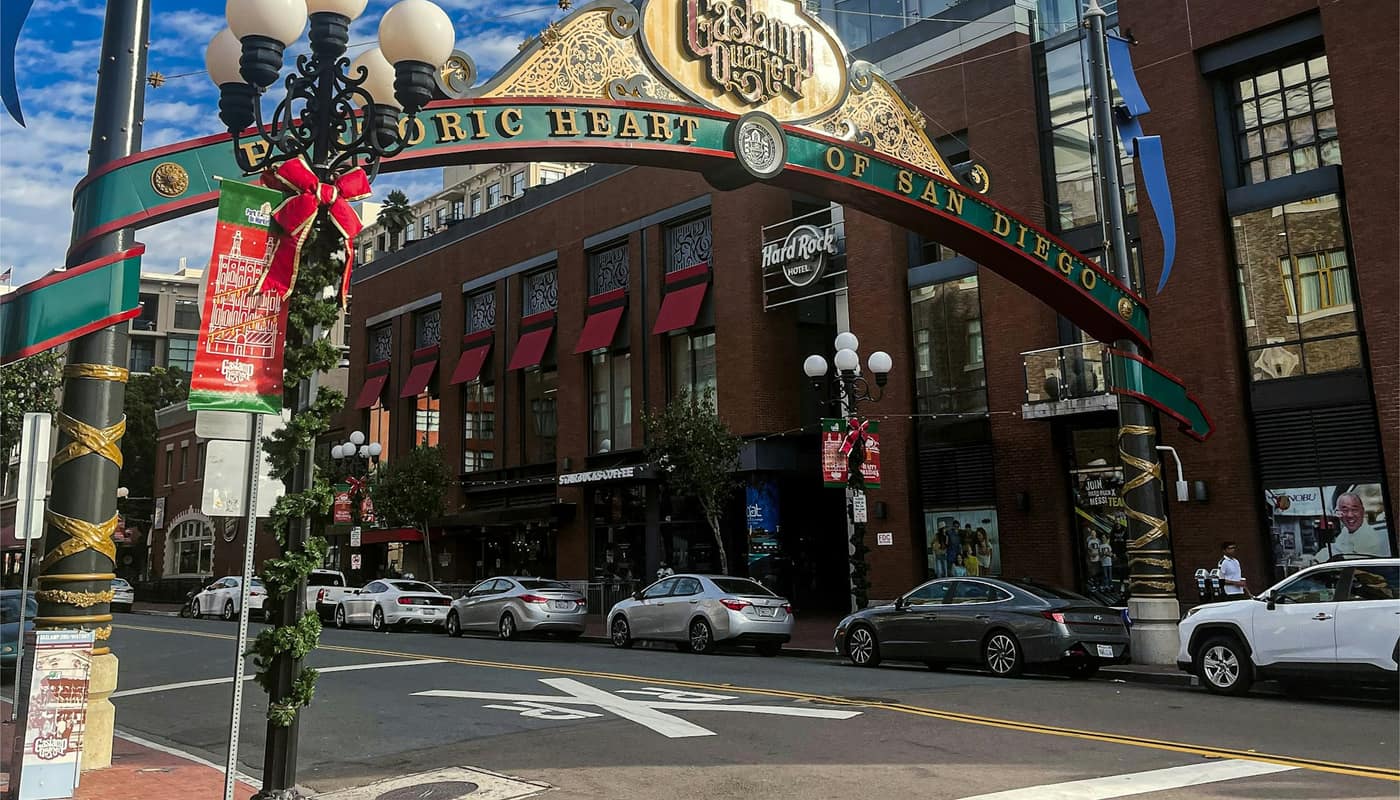
| Green Line | From Santa Fe Depot and the Gaslamp Quarter through Mission Valley and SDSU to the El Cajon Transit Center |
| Orange Line | From Courthouse Station and Civic Center through City College and Euclid Avenue to East County, including La Mesa, Grossmont and El Cajon |
| Copper Line | Between the El Cajon Transit Center and Santee Town Center, with stops including Arnele Avenue and Gillespie Field |
MTS publishes a separate schedule page for each line. Frequencies and hours vary by line, day and time, so the agency’s schedule pages and real-time departures are the place to check before a trip. Those details are not repeated here because they change.
Where do the lines meet, and why does that matter?
A network of four lines only works if riders can switch between them. MTS identifies several shared stations:
- 12th & Imperial Transit Center is served by the Blue, Orange and Green lines.
- Old Town Transit Center is served by the Blue and Green lines.
- El Cajon Transit Center is served by the Orange, Green and Copper lines.
In practice this means a rider going from Santee toward downtown would use the Copper Line and change at El Cajon. A rider going from SDSU to the border would use the Green Line and change to the Blue Line at a shared station such as Old Town. The best transfer depends on the destination, so a trip planner is more reliable than a rule of thumb.
Some stations also have parking. MTS lists pay parking at UTC and at the 12th & Imperial Transit Center, among others, and directs riders to its parking page for specifics.
How much does a Trolley ride cost?
MTS publishes a fare chart that applies to the Trolley. As of the agency’s fare page in November 2026, the adult and reduced fares were:
| Fare type | One way | Day pass |
|---|---|---|
| Adult | $3.00 | $7.00 |
| Reduced (ID required) | $1.50 | $3.50 |
| Rapid Express/Premium | $6.00 | $14.00 |
The pattern is easy to see: the reduced fare is half the adult fare ($3.00 divided by two is $1.50, and $7.00 divided by two is $3.50), and the premium fare is double it ($3.00 times two is $6.00, and $7.00 times two is $14.00). The premium category applies to MTS’s express services rather than ordinary Trolley trips.
MTS says the reduced fare requires identification, and it points riders to a separate Reduced Fares page for eligibility and how to apply. It also describes PRONTO LIFE as a reduced-fare program for low-income riders and says riders aged 18 and under ride MTS and NCTD free through its Youth Opportunity Pass Program with a Youth PRONTO app or card. The eligibility rules are on MTS’s own pages and can change.
How does the “earned” day pass work?
The fare chart labels the day pass column “Day Pass Earned.” MTS describes PRONTO, its fare system, as a way to get the best fare through fare capping, which generally means that the amount charged in a day stops rising once it reaches the price of a day pass. The agency’s page does not spell out the mechanics of the cap, so the following is illustrative arithmetic, not an MTS rule.
Suppose an adult takes two one-way rides: $3.00 plus $3.00 is $6.00. A third one-way ride would bring the total to $9.00, which is $2.00 more than the $7.00 day-pass price. Under a cap set at the day-pass price, the total for that day would stop at $7.00. A rider who makes only one or two trips pays the single-ride fares and never reaches the cap. Anyone relying on this should confirm the current rules with MTS.
How do riders pay?
According to MTS, there are four ways to pay: a PRONTO card, the PRONTO app, a contactless credit or debit card, or cash. The agency’s Trolley and fares pages do not describe how proof of payment is checked, how transfers are treated, or how citations work. For those questions MTS directs riders to customer service at (619) 557-4555, and it lists a separate security line that operates around the clock. Because proof-of-payment rules are a common source of confusion for new riders, it is worth asking the agency rather than assuming.
Who built the Mid-Coast extension, and who pays for it?
The newest part of the Trolley is the Mid-Coast extension of the Blue Line. According to the San Diego Association of Governments (SANDAG), the regional planning agency described in what SANDAG does, the project added 11 miles of light rail and nine new stations running from downtown through Old Town, Mission Bay and the area around UC San Diego to University City. SANDAG says construction began in fall 2016 and the line opened for service on November 21, 2021.
SANDAG gives the project’s cost as about $2.17 billion. It says the Federal Transit Administration provided a 50% match through a Full Funding Grant Agreement signed with SANDAG in September 2016, and that TransNet, the region’s local sales tax for transportation, provided the other half. As simple arithmetic, half of $2.17 billion is about $1.085 billion from each side. SANDAG also says TransNet will cover operating funds for the extension through 2048.
The split of roles is worth noticing. SANDAG’s pages describe it as the agency that delivered the project, while MTS presents the extension to riders as part of the Blue Line. Rounded cost figures can differ between published sources, so SANDAG’s own number is the one used here.
What do people commonly get wrong?
A few misunderstandings come up with the Trolley:
- Assuming one line goes everywhere. There are four lines, and many trips need a transfer at a shared station.
- Treating the Trolley as part of the commuter-rail network. The Trolley is a separate system from Amtrak’s Pacific Surfliner, covered in riding the Pacific Surfliner.
- Reading old fare numbers. Fares are set by the agency and can change, so any figure, including those above, should be checked on the MTS page.
- Assuming the border trip works like a domestic ride. The Blue Line ends at San Ysidro, but crossing the border involves separate steps, described in how to cross the San Ysidro border into Mexico.
What varies by rider and by day?
The fare category depends on eligibility and ID. The best way to pay depends on how often someone rides. The line, the time of day and the day of the week change how long a wait is likely to be. Station parking, where it exists, may carry a charge. Work on the tracks can also change service, and MTS posts service alerts for that.
The Trolley in one paragraph
The Trolley is a four-line light-rail system operated by MTS, tied together by shared transfer stations at 12th & Imperial, Old Town and El Cajon, with an adult one-way fare of $3.00 as of November 2026. Its newest 11 miles were delivered by SANDAG and paid for half by federal money and half by TransNet. Anyone planning a trip should rely on the MTS schedule, fare and alert pages, since they are the authoritative record of what is running and what it costs on a given day.
This article is general information about a public service, not personalized financial or legal advice.
Sources: San Diego Metropolitan Transit System; San Diego Association of Governments