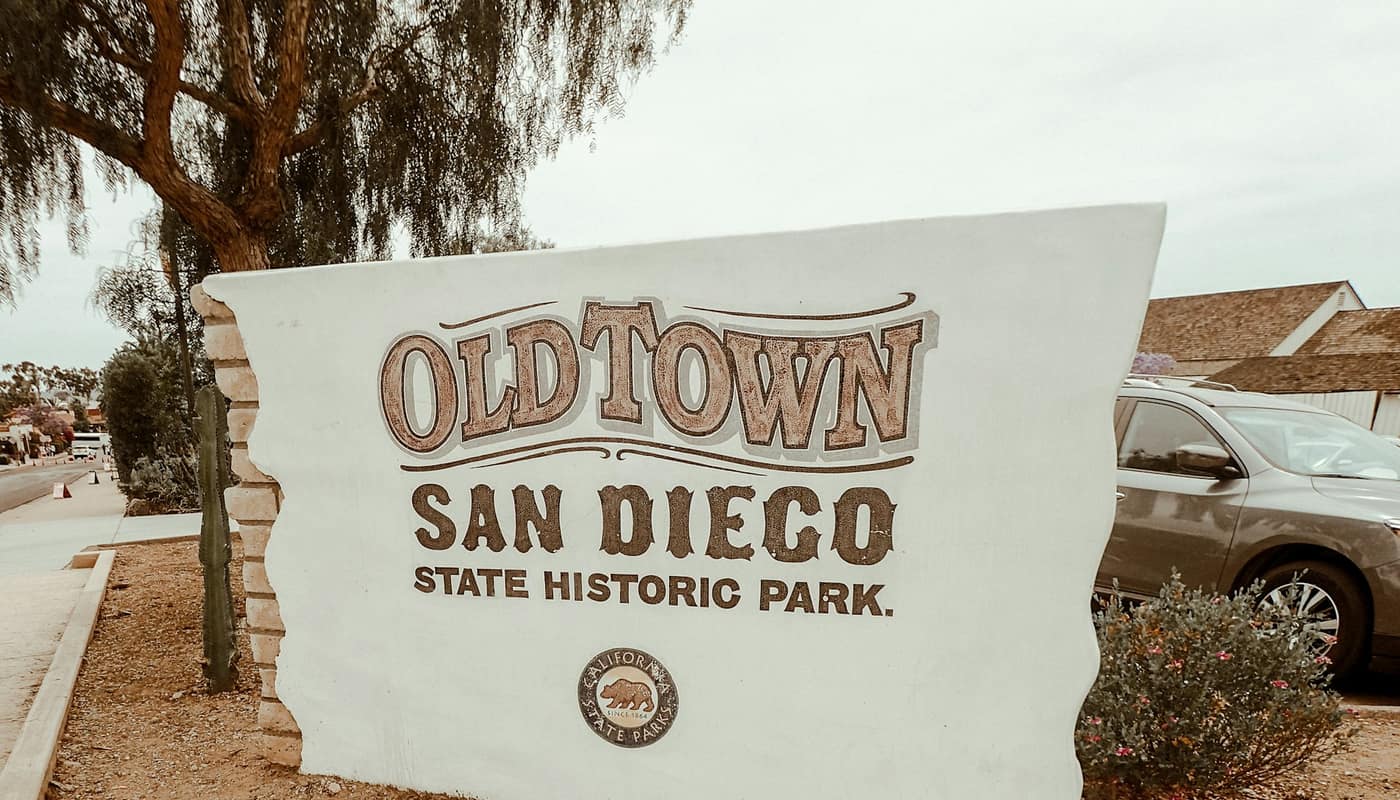
Old Town San Diego State Historic Park is a California State Park where visitors can walk through a cluster of restored and reconstructed buildings from the Mexican and early American periods. This guide explains what is in the park, how its history is told, and what to check before going.
What is Old Town San Diego State Historic Park?
According to California State Parks, the park preserves early San Diego history through historic buildings and living history programs. The agency describes it as a place to “step back in time to experience Mexican California’s Rancho period and life on the American frontier.”
The park is not a single museum. State Parks says it includes five original adobe buildings, restored historic buildings from the period the park interprets, reconstructed sites, and early 20th-century buildings built in a matching style. A Historic Plaza serves as a gathering space for events and demonstrations.
That mix matters for how to read what you see. Some walls are original, some are careful reproductions, and some are later buildings designed to blend in. The National Park Service, which lists the park on the National Register of Historic Places, says the park combines authentic restored buildings with accurate reproductions.
Whose land was this before 1769?
State Parks describes the land as ancestral Kumeyaay territory, and the National Park Service says the Kumeyaay have lived in the region since time immemorial. The park’s outdoor exhibit, titled Iipay ~ Tipai Kumeyaay Mut Niihepok (translated by State Parks as “Land of the First People”), shares the Kumeyaay story on site.
According to State Parks, San Diego became California’s first Spanish settlement when a mission and fort were established in 1769. The National Park Service adds that Spain first claimed the territory in the 1540s and that the first settlers established a mission near today’s Old Town in 1769. For the mission’s own story, see our guide to Mission San Diego de Alcalá.
How did Old Town grow, and why did it survive?
The National Park Service says Old Town’s Euro-American settlement took root in the 1820s, when San Diego was part of newly independent Mexico. State Parks notes that the area later passed to the Mexican government and then became part of the United States after the Mexican-American War. State Parks does not give years for those transitions on its park page.
The National Park Service lists several signposts from the mid-1800s:
| Year | Event, according to the National Park Service |
|---|---|
| 1851 | Robert Israel moved to Old Town |
| 1857 | Thomas Whaley built the Whaley House |
| 1871 | Robert and Maria Israel left Old Town |
| 1870s | San Diego’s center shifted downtown toward the harbor |
The same agency says that shift helped preserve Old Town’s historic structures, because the older settlement was largely spared the redevelopment that affected other early California towns. The Whaley House is part of this story but is not among the buildings State Parks lists on its park pages.
The year the state park was created is reported inconsistently in public summaries, with 1968 the most commonly cited. Readers who need the exact date should confirm it with California State Parks directly. What is clear is that the park’s identity rests on restoration work that kept the original adobes standing and then rebuilt missing pieces around them.
This layered approach is common in historic parks. Original structures anchor the story, reconstructions fill in streets and workplaces that disappeared, and interpretive staff and signs connect the two. In Old Town that means a visitor can move from an adobe family home to a stable to a recreated newsroom in a short walk, each representing a different part of daily life in a small frontier town.
What can you see inside the park?
State Parks organizes its touring suggestions into three self-guided itineraries and recommends allowing at least four hours for the park overall.
An introductory hour
- Robinson-Rose Visitor Center. State Parks says visitors can get a park map here and see a diorama of 1860s San Diego. A tour booklet is available for a small fee.
- McCoy House Museum. The agency says it shows how a Mexican pueblo became an American frontier town.
- La Casa de Estudillo. State Parks calls it a National Historic Landmark and the oldest surviving adobe in the park. The National Park Service says it recreates the lifestyle of San Diego’s upper class during the 1820s.
A longer visit of about two and a half hours
The second itinerary adds La Casa de Machado y Silvas, which State Parks says highlights an early commercial venture from the 1850s, and the Seeley Stable, where vehicles from the 1800s are displayed.
The full day
The full itinerary adds La Casa de Machado y Stewart, described as the home of one of the presidio’s soldiers; the Schoolhouse, which State Parks calls “the first publicly-owned school in San Diego County”; and the San Diego Union Building, a recreated 1868 newsroom with working letter presses.
The park’s main page also lists the First San Diego Courthouse as a museum on site.
Is it only museums, or can you shop and eat there?
Both. State Parks’ page lists a range of businesses operating in and around the park, among them a candy shop, a general store, a leather goods shop, a candle company, a rock and mineral shop, a restaurant group and Kosay Kumeyaay Market, which sells Native-made goods. The page gives only the categories, so details such as menus and prices are best confirmed with each business.
It also lists Cygnet Theatre, a local theater company, among the park’s tenants. For readers interested in San Diego’s stage tradition elsewhere, our look at The Old Globe in Balboa Park covers a different kind of theater history.
What living history programs does the park offer?
State Parks says the park offers living history demonstrations, a working blacksmith shop, guided tours, family programs, music, special events and geocaching. The agency’s calendar on the main page included historic walking tours on November 6 at 10:30 A.M., 12:00 P.M. and 2:00 P.M. as of November 4, 2026. Schedules change, so check the State Parks page for current listings.
When is it open, and what about parking?
As of November 4, 2026, according to State Parks, the Robinson Rose Visitor Information Center and select museums are open from 10:00 A.M. to 5:00 P.M. daily, and museums are closed on Thanksgiving and Christmas. The agency’s page did not list an admission fee. It says parking lots are free for up to four hours and that electric vehicle chargers are available in Lot B.
Dogs are allowed only in outdoor areas such as the plaza, according to the park page. The page also referenced a posted park regulations order dated January 8, 2026. Hours and rules can change, so confirm them before a visit.
How does Old Town fit with other San Diego history sites?
Old Town covers a narrow slice of the region’s past: roughly the Mexican and early American decades. Other cultural places cover different slices. Balboa Park, covered in our visitor’s guide, centers on early 20th-century exposition architecture and museums, while Chicano Park and its murals tell a 20th-century story of community activism. Taken together, they show that San Diego’s character was layered rather than built in one era.
A short planning checklist
- Decide how much time you have. State Parks suggests at least four hours for the park overall, with itineraries of about one hour, two and a half hours or a full day.
- Check the State Parks page for hours, tour times and any closures.
- Read the interpretive signs with the mix of original and reconstructed buildings in mind.
- Visit the Kumeyaay exhibit, which the park describes as telling the story of the people who lived here first.
Reading a place built from many layers
Old Town’s value as a cultural site comes less from any single building than from how it layers Kumeyaay, Spanish, Mexican and American stories in one walkable setting. Its own agencies are open about which parts are original and which are reconstructed, and visitors get the most from the park by keeping that distinction in view. For current schedules and rules, the California State Parks page for the park is the authoritative source.
This article is general information about a public park and is not a substitute for official visitor guidance.
Sources: California State Parks; National Park Service