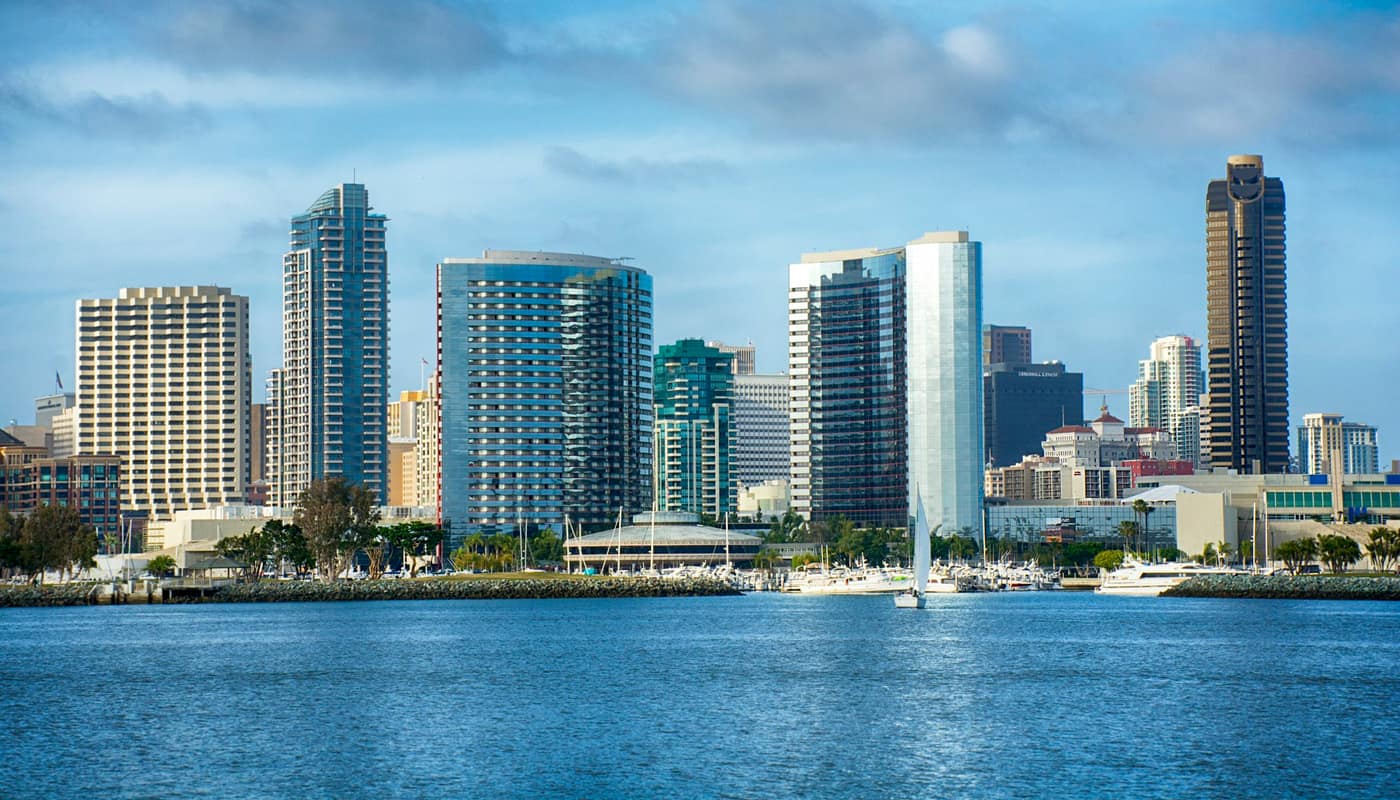
Ask a San Diegan what drives the local economy and the answer depends on whom you ask. A Navy family points to the bases. A biotech researcher points to the mesa of labs north of the city. A restaurant owner points to visitors, and a manufacturer in Otay Mesa points to the border. All of them are right. The regional economy is built on several distinct engines that rarely get described together, and the numbers attached to each vary depending on who is counting and how.
How big is the regional economy?
The San Diego Regional Economic Development Corporation, a business-backed nonprofit that promotes the region, has reported a gross regional product of roughly $267 billion for 2024, with about 1.6 million jobs. Gross regional product is the local counterpart of gross domestic product, the total value of goods and services produced in the area in a year. Figures like these are estimates, and they change with each update, so they are best read as a rough scale rather than an exact count.
The region’s economy is unusually diversified compared with many metropolitan areas, but it is also unusually dependent on a handful of anchor sectors. Understanding those sectors, and the reasons their size is hard to pin down, is the best way to understand the whole.
Why do estimates of the defense economy vary so much?
The military is the sector most often cited, and it is also where published estimates differ the most. The Navy and Marine Corps have a major presence in the region, described in the guide to San Diego’s military presence, and defense contractors, shipyards and research laboratories add to it.
Studies reach different totals because they define the sector differently. Some count only direct spending by the Defense Department. Others also count the “multiplier” effects, in which contractors, suppliers and the households of military and civilian workers spend money locally. A regional report from the San Diego Military Advisory Council has estimated that defense supports tens of billions of dollars in regional economic activity and several hundred thousand jobs, including indirect ones, representing something like a fifth of the local economy by that measure. An older academic estimate put the direct share lower. Both can be correct, because they measure different things.
The practical point for readers is to look at the method behind a figure. A headline that says defense accounts for a fifth of the economy usually includes ripple effects, while a lower number usually counts only the direct payroll and purchases.
What is the life sciences cluster?
Life sciences, a category that includes biotechnology, pharmaceuticals and medical devices, is the region’s other signature industry. It grew out of research universities and institutes clustered near La Jolla and has expanded into a dense network of companies, laboratories and startups. The cluster’s economic role is explored in more depth in the life sciences cluster explained.
The sector tends to pay high wages, and it depends on a pipeline of scientists and engineers trained at local universities, covered in the guide to higher education. It also depends on venture capital, federal research funding and a supply of laboratory space, which is why real estate decisions in the area around the university have regional consequences.
How important is tourism?
Tourism is the most visible industry because visitors fill hotels, restaurants, beaches, theme parks, museums and the convention center. Visitor spending supports a large number of jobs, many of them in hospitality, and it generates tax revenue. The transient occupancy tax on hotel stays is one of the city’s major sources of general revenue, which links the industry to the municipal budget described in how the city builds its budget.
The sector is sensitive to forces outside local control. Economic downturns, changes in travel patterns, airline capacity at San Diego’s single-runway airport, described in how the airport is run, and international visitor flows all affect it. The region also draws large events, including the convention described in the Comic-Con guide, which bring visitors in concentrated bursts.
What does the border mean for trade?
San Diego sits on the busiest land border crossing in the Western Hemisphere. Cross-border trade is not a single industry but a web of manufacturing, logistics and retail. Components move south for assembly in Tijuana and other Baja California cities and return north as finished goods, and shoppers and workers cross daily in both directions. The Port of San Diego, covered in what the Port manages, adds maritime cargo, including fruit, vehicles and other goods.
Because trade flows depend on federal border operations, a change in wait times or in policy can ripple through businesses that rely on just-in-time deliveries. The mechanics of crossing are described in how the San Ysidro crossing works.
What other parts of the economy matter?
Beyond the big four, several other pieces hold the region together:
- Higher education and research, which employ many people and produce the talent that fuels other industries.
- Health care, which is one of the region’s largest employers, with major hospital systems and clinics serving a large and aging population.
- Craft food and beverage, a smaller but high-profile sector, including the breweries described in the craft beer guide.
- Small business, which includes the region’s many sole proprietors, startups and family firms, a theme in how to register a business in California.
- Clean energy and technology, an emerging cluster tied to the region’s climate and research base.
What are the pressure points?
Housing costs are the most commonly cited constraint. High rents and home prices make it harder for employers to recruit and for workers to stay, and they push some workers into long commutes, which connects the economy to the planning and transportation topics in what SANDAG does. Water supply, energy costs and the cost of doing business in California also matter, as does the dependence on federal decisions about defense budgets, research funding and the border.
The region’s strengths are also its exposures. A concentration in defense means exposure to changes in military spending. A concentration in tourism means exposure to downturns in travel. A concentration in biotech means exposure to funding cycles for research and to the willingness of investors to back startups.
Who benefits, and who is left out?
Aggregate figures hide a great deal of variation. High-wage jobs in research and engineering sit alongside lower-wage jobs in hospitality and retail, and the gap between them shows up in housing affordability and in which neighborhoods have seen investment. Economic development agencies tend to emphasize totals, while community groups and labor organizations tend to emphasize who gets the jobs and at what pay. Reading both kinds of reports gives a fuller picture than either alone, and it is one reason local debates about development, wages and housing so often turn on questions of distribution rather than size.
How to follow the numbers
Anyone who wants to track the economy over time can use several public sources. The U.S. Bureau of Economic Analysis publishes regional GDP data, the California Employment Development Department publishes jobs and unemployment figures for the county, and local organizations, including the Economic Development Corporation and university research centers, publish regular reports on specific sectors. The City of San Diego’s annual budget includes an economic profile, and the county and the Port publish their own data. The best habit is to compare sources, check the year and ask how each figure was calculated.
Sources: San Diego Regional Economic Development Corporation; San Diego Military Advisory Council; U.S. Bureau of Economic Analysis; California Employment Development Department; City of San Diego Economic Development Department